Companies receive hundreds or thousands of calls every month. Some end in a sale, an appointment, or a resolved inquiry. Others are lost because no one answers, the team is busy, or the call arrives outside of business hours.
That is why, before implementing an AI voice agent, there is a much more important question than "how much does it cost?":
How much value can it generate or save for my business?
ROI, or return on investment, allows you to answer precisely that question. In this article, we explain how to calculate the ROI of a voice agent, what variables you need to consider, and how to apply the formula with practical examples.
What is the ROI of an AI voice agent?
The ROI of an AI voice agent measures how much economic benefit an automation generates in relation to what it costs to implement and maintain. To calculate it, the savings and additional revenue generated by the agent are compared with its total cost.
In other words, it is not enough to compare the price of an AI platform with a person's salary.
A voice agent can generate value in several ways: avoiding missed calls, saving working hours, increasing appointments or sales, and automating tasks that previously required manual intervention.
Therefore, to calculate its ROI correctly, both the costs and the value it provides must be considered.
How is the ROI of a voice agent calculated?
The basic formula is:
ROI = (benefit generated − investment cost) / investment cost × 100
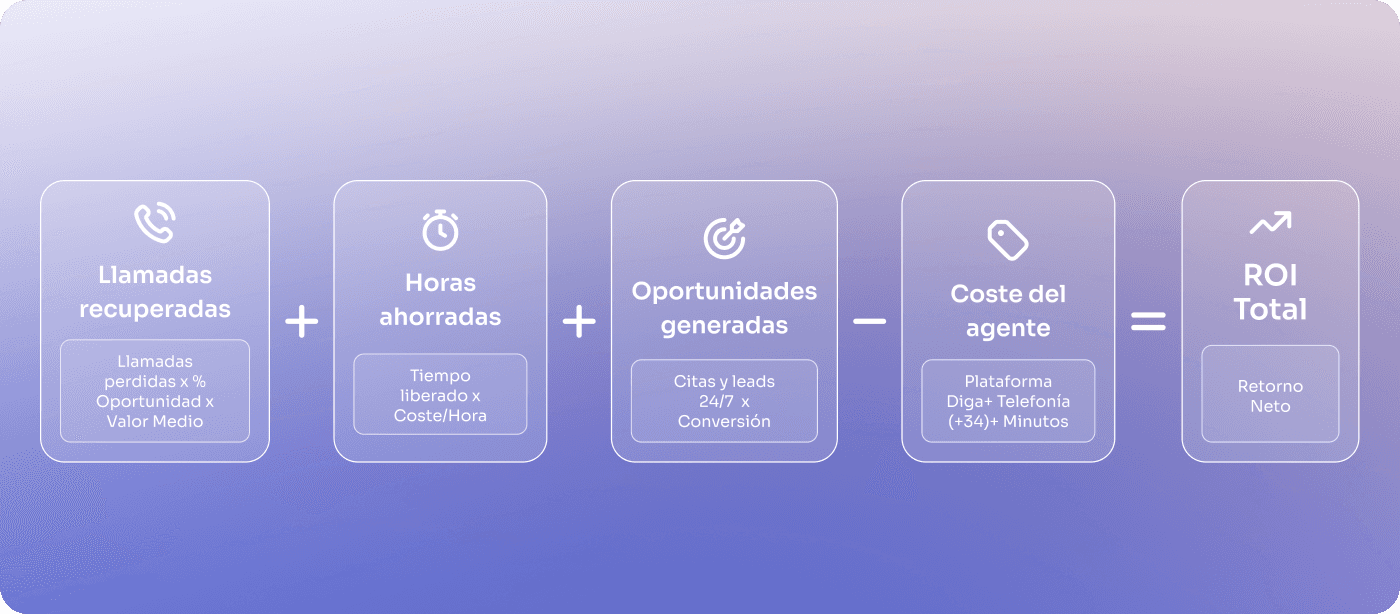
For a voice agent, we can simplify the calculation into four variables:
Additional revenue: opportunities, sales, or appointments that were previously lost.
Saved costs: working hours that the team no longer spends on repetitive tasks.
Agent cost: platform, telephony, minutes, and other associated services.
Analyzed period: usually a month or a year.
For example, if an automation generates €3,000 in monthly value and costs €500, the net benefit would be €2,500.
ROI = (3,000 − 500) / 500 × 100 = 500%
That means that for every euro invested, five additional euros of net return are generated.
What costs should you include?
To avoid overestimating the ROI, include all relevant costs:
Platform subscription.
Telephony minutes.
Configuration costs, if any.
Necessary integrations.
Time spent setting up and maintaining the agents.
Other external services that are part of the solution.
One of the advantages of using an all-in-one platform is precisely reducing complexity and avoiding having to aggregate multiple telephony, voice, automation, and infrastructure providers.
The 3 main sources of return from an AI voice agent
The value of a voice agent does not come solely from reducing costs. In many businesses, the greatest return lies in not losing opportunities that are already coming in by phone.
1. Recovering calls that were previously lost
Imagine a company that receives 1,000 calls per month and fails to answer 15% of them.
That means 150 calls go unanswered.
If a portion of those calls corresponds to potential customers, each missed call has an opportunity cost.
For example:
150 lost calls.
20% were business opportunities.
Average value per customer: €200.
The potential lost value would be:
150 × 20% × €200 = €6,000 per month
This does not mean that all of those calls would have ended in a sale. But it does allow for an estimate of how much potential business is being left out of the sales process.
A voice agent can answer those calls even when the team is busy or outside of regular hours.
2. Saving the team time
Not all calls have the same value.
Many consist of repetitive tasks:
confirming an appointment;
checking schedules;
answering frequently asked questions;
changing a reservation;
collecting data;
qualifying a lead;
checking the status of a procedure.
If a person spends several hours a day on these tasks, there is an associated cost.
Suppose an employee spends 20 hours per month on repetitive calls and the company cost of those hours is €25.
The monthly cost would be:
20 × €25 = €500
If the agent automates a large part of those tasks, that €500 represents an initial reference for potential savings.
And the benefit is not only economic: the team can dedicate that time to tasks that truly require human judgment.
3. Increasing call conversion into opportunities
A voice agent can also participate directly in sales processes.
For example, it can:
respond immediately to a lead;
ask qualification questions;
identify their needs;
check availability;
book a meeting;
transfer to the sales team when necessary.
This is especially relevant when response speed influences the probability of conversion.
Instead of a call ending up in a voicemail or on hold, the user gets an immediate response.
Practical example: calculating the ROI of a voice agent
Let's look at a simple scenario.
A company receives 1,500 calls per month and currently fails to answer 150.
Of those calls, it estimates that approximately 20% are business opportunities and that the average value of each customer is €150.
The potential value associated with those calls would be:
150 × 20% × €150 = €4,500
Now let's assume that the agent allows for the recovery of a portion of those opportunities and, additionally, automates tasks that accounted for €400 monthly in team time.
If we estimate a recovered value of €2,000 and a savings of €400, the monthly return would be €2,400.
If the total cost of the solution was €400 per month:
ROI = (2,400 − 400) / 400 × 100 = 500%
This example is illustrative only. The actual ROI will depend on the volume of calls, the value of each opportunity, the percentage of automatable calls, and the cost of the solution.
The advantage of using this methodology is that you can substitute the values with those of your own business.
How to know if a voice agent is profitable for your company?
Not all businesses need to automate the same type of calls.
Before implementing an agent, analyze these five variables:
Call volume
The more calls your business manages, the greater the potential for automation.
Percentage of missed calls
If a significant portion of calls goes unanswered, there is a clear opportunity to recover business.
Value of each call
Losing a €20 call is not the same as losing a €2,000 business opportunity.
Time spent by the team
Calculate how much time is currently spent on repetitive calls and what cost that represents for the company.
Automation capability
Identify which tasks can be resolved from start to finish through AI and which should continue to require human intervention.
A good strategy is not about automating all calls, but about automating those where AI can add the most value.
ROI of a voice agent by business type
The return can come from different sources depending on the sector.
Type of business | Main opportunity | What an agent can automate |
Clinics | Appointments and missed calls | Confirmations, bookings, and rescheduling |
Real Estate | Lead generation | Qualification and follow-up |
Agencies | Customer management | Qualification, support, and outbound calls |
Local businesses | Telephone customer service | Frequently asked questions, reservations, and transfers |
For example, for a clinic it may make more sense to measure recovered appointments and administrative hours saved.
For a real estate agency, on the other hand, it may be more relevant to measure qualified leads and opportunities generated.
And for an automation agency, ROI can also be measured by the ability to create and manage agents for multiple clients from a single platform.
How much can a voice agent save?
There is no universal figure.
Savings depend mainly on the number of calls, their duration, the type of task, and the cost of the labor being automated.
The best way to calculate it is to start with your own data:
Automatable calls × average time per call × hourly cost = potential savings
For example, if you automate 500 monthly calls that last an average of 4 minutes, you would be automating more than 33 hours of work per month.
From there, you can calculate what that time represents for your company.
Additionally, you must add the value of calls that previously went unanswered and the opportunities that can be recovered.
💡 Want to know your company's exact ROI in 2 minutes? Forget about doing manual calculations. Speak directly with Melo, the co-pilot of Diga, tell him how many calls you receive per month, and let him simulate your estimated savings and return instantly.
Why can an all-in-one platform improve ROI?
The cost of a voice agent does not depend solely on its minutes of conversation.
When a company builds its infrastructure with different providers, it can end up managing separately:
telephony;
voice models;
agent infrastructure;
automations;
integrations;
monitoring tools.
This increases both cost and operational complexity.
An all-in-one platform like Diga centralizes these capabilities to create, deploy, and manage agents from a single environment. This is especially relevant when you also want to automate outbound calls and navigate IVRs autonomously.
Furthermore, with Melo, Diga's co-pilot, you can create and modify agents by describing what you need in natural language, without having to program every behavior from scratch.
This reduces the time needed to put an automation into production and, especially for agencies and integrators, makes it easier to replicate solutions for different clients.
How to improve the ROI of your voice agent
Once the agent is running, the ROI calculation should not end.
Periodically analyze:
calls answered;
recovered missed calls;
appointments or meetings generated;
tasks completed automatically;
time saved for the team;
transfers to human agents;
cost per call;
conversions generated.
With this data, you can identify which flows perform best and where it makes sense to expand automation.
Voice AI should not be measured solely by how many calls it answers, but by the value each call generates.
Conclusion: the true cost is not always in the AI
Calculating the ROI of a voice agent is not simply about comparing the price of a platform with the cost of hiring a person.
The most complete calculation must consider how much money you are missing out on due to calls you do not answer, how much time your team spends on repetitive tasks, and how many additional opportunities an automation can handle.
If those costs are high enough, a voice agent can shift from being a technological tool to becoming an investment with a measurable return.
With Diga, you can create voice agents without programming, connect them with your business tools, and manage inbound and outbound calls from a single platform.
Want to discover how much automation could bring to your business? Create your first agent with Diga and start measuring the return from the very first calls.