Legal disclaimer: This article is for informational and educational purposes only. It does not constitute formal legal advice.
Artificial intelligence has gone from being a promise of the future to managing phone support, schedules, and sales for thousands of businesses every day. However, along with this operational acceleration, an inevitable question has arisen on the tables of directors and founders: to what extent is European regulation going to limit or penalize the use of AI in my business.
The short answer is that it is not here to slow down your growth, but to set clear rules of the game. With the entry into force of the European Artificial Intelligence Regulation (AI Act), the European Union seeks to ensure that technology is safe, transparent, and respectful of people's rights.
If your company is already using automated tools or you are considering integrating an AI voice agent to avoid missing incoming calls or to manage campaigns, it is natural to wonder what obligations apply to you. In this guide, we explain, without incomprehensible legal jargon, what the current legal framework in 2026 requires and how to adapt without complicating your life.
What is the AI Act?
Direct answer: The AI Act (Regulation EU 2024/1689) is the unified regulatory framework of the European Union that classifies artificial intelligence applications according to their level of risk. Its goal is to protect the safety and fundamental rights of citizens, demanding transparency and control without preventing business technological innovation.
This pioneering regulation does not evaluate artificial intelligence in a generic way, but instead examines the specific use case for which you use the tool. An algorithm that evaluates the granting of a mortgage is not the same as a system that answers questions about a clinic's opening hours or schedules a real estate appointment.
The regulation establishes a scale of responsibilities in which, the greater the potential impact on people's lives or privacy, the greater the required technical and legal requirements will be.
Real application schedule and what is already in force in 2026
Unlike outdated summaries that still cite the initial dates from 2024, the real application schedule of the AI Act works like this:
February 2, 2025 (In force): Prohibition of unacceptable risk practices (Art. 5) and obligation of AI literacy (Art. 4) for all personnel operating AI systems.
August 2, 2025 (In force): Regime for general-purpose AI models, governance, and sanction framework.
August 2, 2026 (Imminent application): General application of the regulation, including transparency obligations for voicebots and chatbots (Art. 50).
December 2, 2027: Application to High-Risk systems under Annex III (adjusted deadline following the update of the Digital Omnibus, Regulation EU 2026/1744).
August 2, 2028: Application to High-Risk systems integrated into products (Annex I).
How does the AI Act classify AI systems?
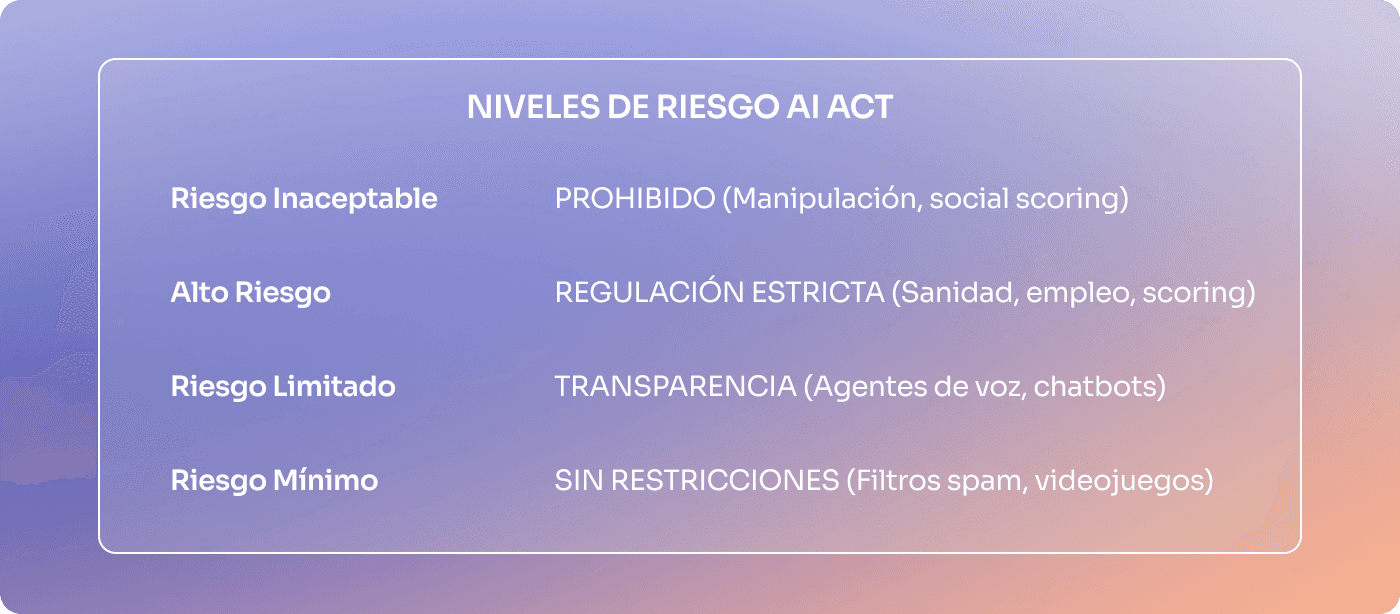
To understand how this law affects your company, the AI Act divides technology into four distinct levels of risk:
1. Unacceptable risk (Prohibited systems)
All applications that pose a threat to the rights of citizens, such as social scoring or subliminal manipulation tools, are strictly prohibited.
2. High risk
Systems that directly influence crucial decisions (recruitment, medical diagnosis, credit scoring, or access to essential services).
Watch out for voice agents in HR: If you use a voicebot to conduct initial interviews or phone screening of candidates, that interaction falls directly into the High Risk (Annex III) category, requiring audits, EU registration, and CE marking.
3. Limited risk (Phone support and chatbots)
This is where the vast majority of AI voice agents and conversational assistants that handle calls are located. It does not require complex high-risk audits, but it establishes an indispensable condition under article 50.1: transparency. The user must be informed that they are interacting with an automated system.
4. Minimal or no risk
Covers the vast majority of everyday internal tools (spam filters, recommendation systems). They do not require additional measures.
What does the AI Act imply for AI voice agents?
If you use or plan to deploy a phone assistant for your business or for your agency's clients, the good news is that general commercial voice agents are not part of the high-risk category.
However, to operate legally in a simple way, you must keep in mind three legal and management pillars:
1. Mandatory transparency (Art. 50.1 AI Act)
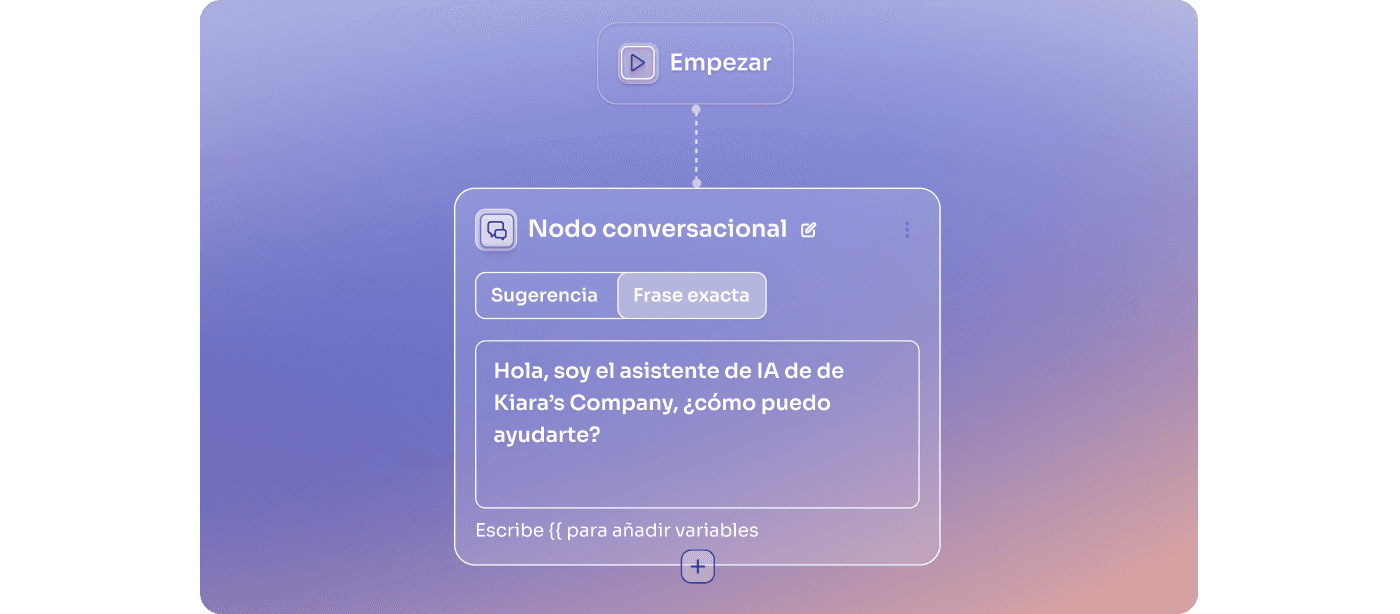
Your phone agent must clearly identify itself at the beginning of the conversation. A simple "Hello, I am the virtual assistant of [Company]" complies perfectly.
What if the robot sounds too hyper-realistic? The more human and natural the voice sounds (thanks to low-latency Speech-to-Speech models), the less the exception that "it is obvious from the context" applies. Therefore, it is even more mandatory and critical to include the initial transparency notice.
2. AI literacy for staff (Art. 4 AI Act)
Since February 2025, the AI Act requires any company using AI systems to ensure that its staff has an appropriate level of training. This implies that employees who configure, monitor, or handle handovers from the voice agent must understand how the tool works and what its limits are.
3. Sanctions framework
Failure to comply with the transparency obligations of Article 50 or the requirements of the regulation carries penalties of up to 15 million euros or 3% of total global annual turnover (for SMEs and startups, the lower amount applies, according to Art. 99.6).
What if you use AI for outbound calls? (LGTel and AEPD)
The entire framework of the AI Act regulates the technology, but if your company conducts outbound telephone campaigns in Spain, you must comply with telecommunications and data protection regulations, supervised by the Spanish Data Protection Agency (AEPD):
Article 66.1.b of the LGTel (Law 11/2022): Prohibits unsolicited commercial calls without prior consent or a justified prior contractual relationship.
100% automated calls (Art. 66.1.a LGTel): Calls made through automated systems without direct human intervention require prior explicit consent from the user.
Consultation of the Robinson List: It is mandatory to consult advertising exclusion files (Art. 23 LOPDGDD) before launching any outbound telephone campaign.
If you manage a marketing agency, a technology consultancy, or work as a solutions integrator, this regulatory framework is a golden opportunity to stand out. When looking for the right solution for your clients, having a voice agent platform for agencies allows you to deploy telephone assistants adapted to the best practices of European regulations from day one, saving you complex audits and guaranteeing the privacy of each project.
Compliance with the AI Act with Diga
To give you a clear picture of how the requirements of the European Regulation translate into the day-to-day operations of your technology, here is how our platform addresses each of the legal pillars:
Compliance and best practices with Diga
To give you a clear picture of how regulatory requirements and operational best practices translate into your day-to-day work, here is how our platform addresses each point:
Why is it important? | Mandatory by law? | How does Diga solve it? | |
Transparency in the call | The user must know they are speaking with an AI to avoid confusion. | Yes (Art. 50.1 AI Act) | Configurable welcome message from the "Melo" co-pilot to explicitly identify itself in the first sentence. |
Agent version control | Knowing exactly what instructions or prompts the agent had on a specific date. | Operational best practice | Version control system: Allows you to know at any time which version of the agent was deployed and audit the change history. |
Traceability and audit | Record call behavior and review the source of data in case of potential errors. | Recommended (and required under GDPR) | Detailed real-time logs with call history, tools used, exact transcription, and execution. |
Human supervision (Handoff) | Allow intervention or transfer when the call exceeds the system's capacity. | GDPR Guarantee / Best practice | Seamless handoff to a human by directly transferring the phone call to the support or reception team. |
Data protection | Process and store client information with European Union guarantees. | Yes (GDPR) | European infrastructure, strict compliance with the GDPR, secure processing, and allocation of local numbering (+34). |
💡 Looking to comply with the AI Act without technical complications?
With Diga, the "all-in-one" platform for AI voice agents in Spain, you can configure your phone assistant in minutes using the "Melo" co-pilot. It includes automatic transparency notices, version control, low-latency infrastructure, and full compliance with GDPR with Spanish numbering (+34). Try Diga today with no obligation.
Best practices to prepare your company
Adapting to the new European Union regulation does not require hiring an expensive legal consulting firm if you follow these practical steps:
Always inform your users: Review your voice agent's welcome scripts. Make sure the first sentence clearly states that the interaction is being conducted through an artificial intelligence system.
Audit your technology providers: Avoid fragmented solutions where your clients' data travels through multiple external APIs from different countries without clear privacy guarantees. Prioritize consolidated platforms that manage the entire cycle in Europe.
Set up smart call forwarding: Configure direct transfer rules. If a client requests to speak with a person or if the call detects a complex case, the voice agent must be able to transfer the call to your team seamlessly.
Manage your AI's change history: Use platforms that include a versioning system. This way, you will know exactly what instructions or prompts your agent had active on any past date in the event of an internal review or audit.
Risk classification matrix by tool type
Below is a summary of how the AI Act's legal framework affects different types of AI tools implemented in the company:
Type of AI tool | AI Act Classification | Main Requirement | Complexity Level |
Voice agent for commercial calls (Diga) | Limited Risk | Transparency (Art. 50) and GDPR | Low (Automatic setup) |
Customer service chatbot | Limited Risk | Clear identification as an AI system | Low |
Spam filters and basic CRM | Minimal Risk | No special requirements | None |
HR screening/interview voicebot | High Risk (Annex III) | Audit, impact assessment, and EU registration | High |
Credit or insurance scoring software | High Risk | Human oversight, assessment, and explainability | High |
Should all companies worry?
The clear answer is no, you should not worry, but you must take action.
The AI Act is not designed to penalize the small business that wants to answer calls for its medical clinic outside of business hours, nor the agency that creates voice assistants to automate appointments. The law targets abusive, opaque, and discriminatory uses of technology.
If you choose the right tools, legal adaptation is practically automatic. Modern platforms like Diga unify the voice infrastructure, voice-to-text conversion, and conversational logic into a single subscription adapted to the regulations, preventing you from having to worry about integrating multiple external APIs or managing complex cross-border privacy policies.