How many times have you hung up the phone in frustration after hearing "For billing, press 1; for support, press 2"? Even worse: how many hours does your team waste calling suppliers, insurance companies, or carriers only to get stuck in their endless phone menus?
The traditional interactive voice response (IVR) system revolutionized phone customer service in the nineties. However, it has become a double bottleneck: it annoys your customers when they call your business, and it wastes your team's time when they have to make outbound calls.
In this guide, we will analyze the ultimate evolution of the voice channel: how AI agents are not only replacing obsolete switchboards, but are also incorporating the ability to autonomously navigate IVR menus, helping your company to reduce operating costs and improve its return on investment.
Why have IVRs always been a problem for automation (and what has changed now)?
For years, telephone switchboards and IVR menus were the great "black box" that automation could not cross. If you programmed a voice bot to make outbound calls and it hit an external switchboard, the system would collapse.
The great historical obstacle
Traditional bots operated with a rigid framework of Text-to-Speech and stage-by-stage transcription. They presented three insurmountable barriers:
Inability to understand tones and menus: Traditional software did not know how to "listen" to a voice prompt while it was playing to identify the exact second to send the keypad signal (DTMF).
Accumulated latency: The delay of several seconds in processing the audio caused the destination switchboard to consider the call failed or hang up due to lack of response.
Lack of context: If the menu said "State the reason for your call in a few words", the bot failed to adapt its response to the vocabulary expected by the switchboard.
The Speech-to-Speech models revolution
What has changed is not telephony, but Artificial Intelligence. The arrival of ultra-low latency voice-to-voice (Speech-to-Speech) models allows the AI to process audio in real time, just like a human ear.
Today, platforms like Diga not only interpret what the voice prompt is saying instantly, but can also emulate keystrokes (DTMF tones) or respond with short spoken phrases to cross any phone menu without human intervention.
What is Intelligent IVR Navigation with Voice AI?
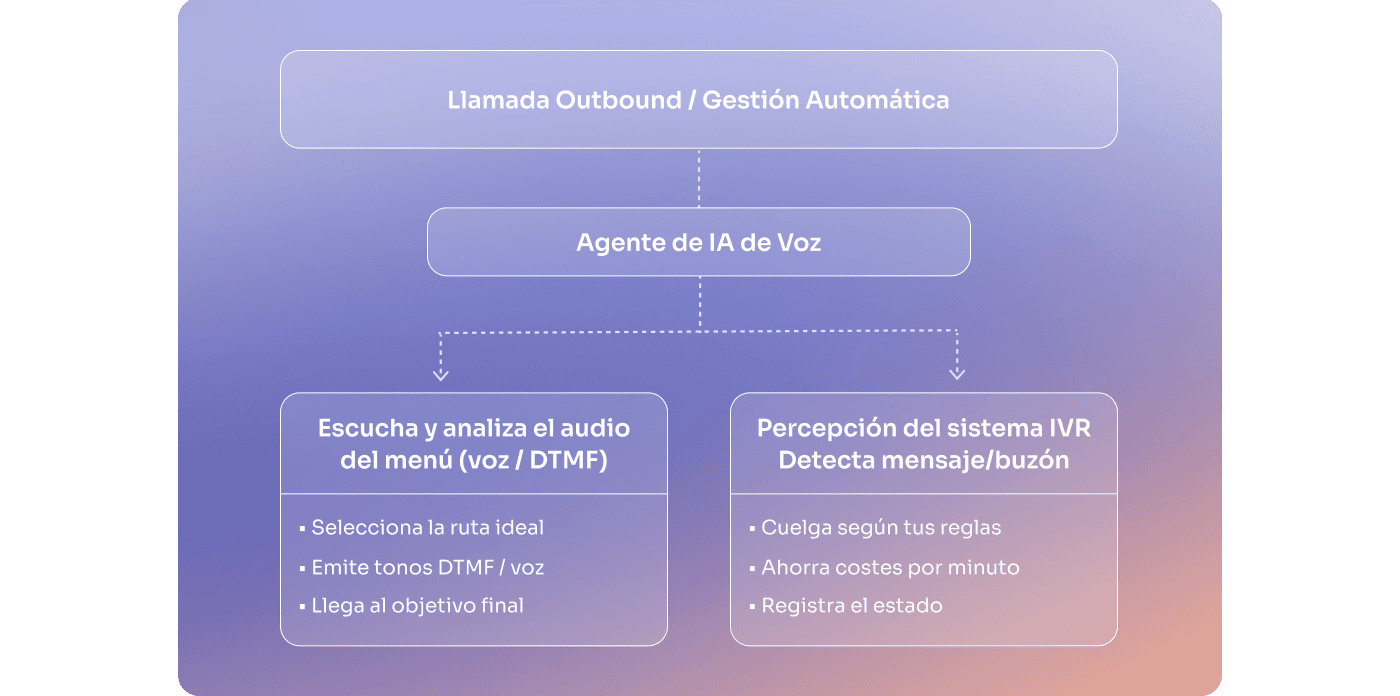
Quick Answer (Featured Snippet): Autonomous IVR navigation is a voice AI feature that allows a conversational agent to interact directly with third-party phone menus. The agent interprets audio messages, emits DTMF tones or voice commands to advance through the menu, detects system responses, and intelligently resolves tasks or hangs up the call without human intervention.
Until very recently, IVR menus were an insurmountable barrier for automation. When a bot made an outbound call and hit a switchboard, it stalled.
Today, the Diga platform integrates advanced context recognition and DTMF signaling capabilities that allow your AI agents to "talk" directly to market switchboards, intelligently traversing them as if they were an experienced human operator.
The two sides of automation: Replacing vs. Navigating an IVR
To understand the true operational impact on your company, it is essential to differentiate between the two scenarios where Diga's voice artificial intelligence operates:
1. Inbound (Incoming calls to your company)
You replace your old IVR with a seamless conversational agent. The customer does not need to press buttons; they speak naturally, pose their query, and Diga's AI resolves it in real time or routes it to the correct department with all the context.
2. Outbound (Outgoing calls from your company to third parties)
This is where the true competitive advantage lies: your AI agent makes calls to other telephone systems.
Menu navigation: The agent understands what it is looking for (e.g., "check claim status"), listens to the destination switchboard's options, sends the keypad tone (DTMF) or the exact phrase to advance, and goes directly to the information or the right person.
Perception and decision making (IVR and Hang-up Detection): Your agent does not improvise: it does exactly what you tell it to do. If it encounters a closed loop, an answering machine, or a dead-end menu when calling, the agent perceives the environment and executes the rule you have programmed (for example, hanging up immediately to avoid wasting time). This allows you to save phone credit minutes and prevent your databases from getting clogged with inefficient calls.
Feature Comparison: Traditional IVR vs. Diga's AI with Navigation
Comparison Criterion | Traditional IVR | Voice AI Agent (Diga) |
Incoming support (Inbound) | Rigid menus and long wait times. | Fluid conversation in natural language. |
Outgoing calls (Outbound) | Cannot interact with other switchboards. | Autonomous navigation: Selects options and emits DTMF tones. |
Intelligent environment detection | Remains on the line regardless of context. | IVR/Voicemail perception: Hangs up immediately if not useful. |
Technology stack | Fragmented (PBX, CRM, VoIP, integrators). | Unified: All features in a single subscription. |
Agent setup | Requires programmers and months of work. | No-code: Created by chatting with the copilot Melo. |
Connectivity and compliance | Complex SIP networks and manual legal adjustment. | Spanish numbers (+34) and strict GDPR compliance. |
Strategic Use Cases: How IVR Navigation Transforms Your ICPs' Operations
The ability to autonomously navigate or hang up on phone menus resolves massive bottlenecks in industries where outbound call management is intensive.
1. Medical clinics and insurance management
The problem: Reception staff lose hours calling health insurance providers' professional helplines to authorize medical tests or verify a patient's coverage. Each call requires navigating 4 or 5 levels of menus.
The solution with Diga: Diga's AI agent makes the call to the insurer, listens to the voice prompt, presses the corresponding options for "Authorizations," inputs the policy number using DTMF tones, gets the response, and updates the patient's record.
Result: Administrative management time reduced by more than 80%.
Discover how clinics reduce no-shows and recover lost revenue in our guide to automating appointments and reminders in medical clinics.
2. Real estate agencies and owner prospecting
The problem: Real estate agencies run outbound campaigns to list properties or verify the status of properties posted by individuals or banks. Many calls end up in automated switchboards or answering machines, wasting budget-per-minute and time.
The solution with Diga: The agent calls the list of phone numbers. If it detects that the call is answered by an irrelevant IVR menu or a voicemail, it perceives the system and hangs up instantly to avoid wasting time or credit. If a real person or a navigable booking menu answers, it advances and qualifies the owner.
3. Marketing agencies, integrators, and B2B intermediaries
The problem: Creating automations that rely on speaking to external vendors (e-commerce with shipping carriers, agencies with public administrations) used to require expensive or impossible API integrations.
The solution with Diga: Agencies can sell their clients agents capable of calling shipping companies, navigating their IVR, obtaining a package's location, and notifying the final customer via phone or WhatsApp.
Want to see how it's programmed in real time? We have prepared a step-by-step tutorial where we show you on-screen how to configure your agent to bypass switchboards automatically in less than 5 minutes. Watch video on YouTube: How to program your AI to bypass IVR Menus and automatic switchboards
ROI Estimation: How to Calculate the Financial Impact on Your Business
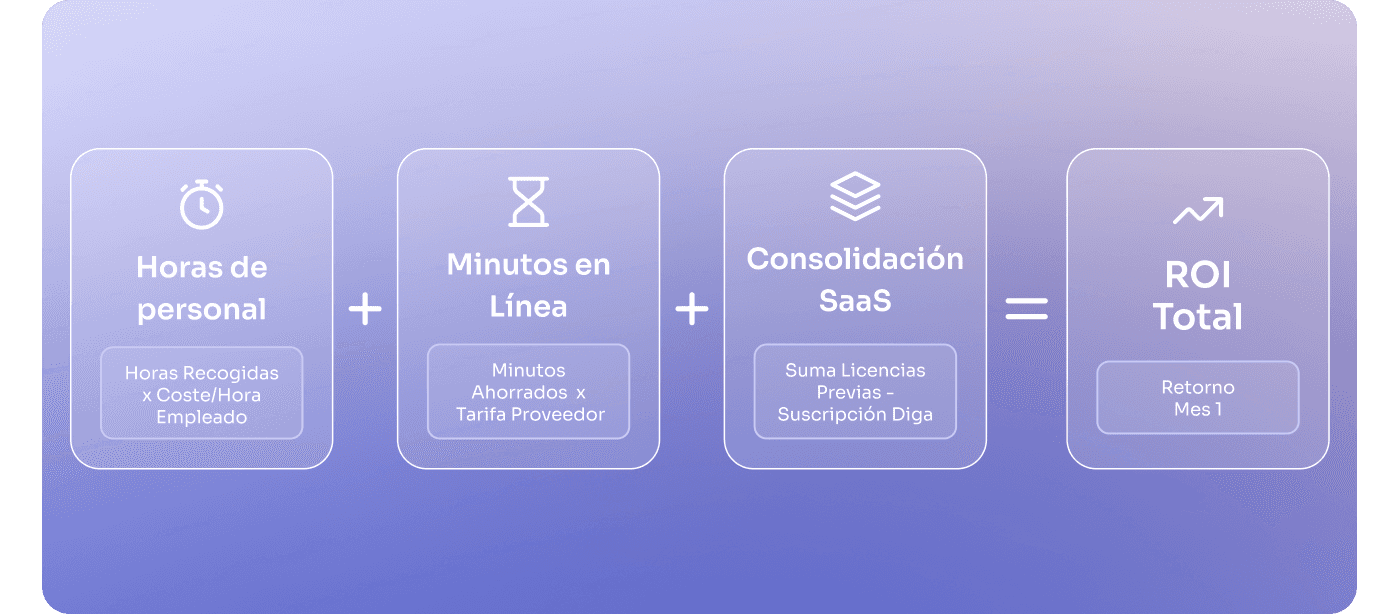
To understand the return on investment when implementing this technology, it is advisable to analyze savings through an operating cost methodology divided into three variables:
Savings in human management time: Calculate how many hours per month your team spends navigating external switchboards or answering repetitive questions. Multiplying those hours by your staff's average hourly cost reflects the first direct saving.
Phone minutes optimization: By programming rules for the agent to hang up immediately upon encountering an answering machine or a failed IVR, you eliminate credit consumption on calls with no business outcome.
Software consolidation: You replace individual contracts with VoIP providers, dialer systems, transcription, and switchboard licenses with a unified platform like Diga.
How to Configure Agents That Navigate IVRs with the "Melo" Copilot
Integrating a feature as advanced as menu audio interpretation and DTMF tone generation used to require custom engineering developments for months. At Diga, the complexity has been resolved at the infrastructure level so that any user can use it using natural language.
Thanks to the integration of the copilot Melo, you only need to instruct your agent with phrases as simple as: "If you find a phone menu when calling, press the support option and request the status of the file. If you detect that it is a voicemail or a dead-end menu, hang up immediately and log the call".
All this operating on native infrastructure in Spain, guaranteeing strict compliance with GDPR for managing sensitive data in every phone conversation.
Evolve Your Phone Channel with Diga's Artificial Intelligence
The telephone has ceased to be a tool of rigid menus and exasperating waits. Today, Artificial Intelligence not only serves your clients with human fluidity, but is also capable of navigating third-party telephone systems for you, eliminating the repetitive tasks that slow your team down.
With Diga, you unite the management of incoming calls, outgoing campaigns, and intelligent IVR navigation in a single, easy-to-use, no-code platform that is 100% adapted to European regulations.
Ready to automate your company's telephony from start to finish?
👉 Create your first AI agent with Diga today and start for free