How AI is changing the way we create voice agents, automate calls, and build telephone customer service without technical setups.
Two years ago, turning a software idea into something real meant one of two things: learning to code or paying someone who knew how. Today you go to Lovable, type "I want an app to manage my gym's bookings," and after a while you have a working application. You haven't touched a line of code, you simply described what you wanted and the AI built it.
At Diga we have brought that same idea to voice agents. In this article we explain how voice agents were built up until now, what changes when you create them by talking with a copilot instead of configuring them by hand, how far that approach goes, what problems are still open, and why we believe this is how next-generation voice agents will be built.
The shifts in the background: you no longer program, you describe
Many of you might know about vibe coding, the idea of programming simply by sending prompts to an AI. In a matter of months it went from being a Twitter meme to becoming the method that many people follow when creating or developing a product.
Lovable became one of the fastest-growing software startups in history, going from zero to 100 million dollars in recurring revenue in eight months and reaching a valuation of 6.6 billion by the end of 2025, because it tore down a requirement that had stood for decades: to make software, you had to be a programmer. Today, hundreds of thousands of projects are launched daily on its platform, many by people who have never written a single line of code. And it is not the only example; we can find other similar platforms like Cursor, v0, or Replit.
But the important change is not Lovable, Cursor, or v0. It is the change of interface. For fifty years, asking a computer for something new required an intermediate language: code. AI made that language unnecessary, now you describe the intent and the machine takes care of the execution.
Apps were only the first domain to fall, the next is voice agents.
How voice agents were built with AI until now
Setting up a voice agent to answer your business phone has never been a single afternoon of work. You have to configure the telephony and connect a number. You have to write the prompt that defines how the agent speaks and what it does. You have to connect the integrations, as we want it to be able to edit the CRM or send an email. If we want it to have information about our business, we have to select the documents it needs to have in its context. And then test, listen to calls, adjust, and repeat.
None of that is impossible, but currently, to have a voice agent, you need a person who knows how to set up the prompts, telephony, and integrations.
Melo, you describe the agent and it gets built
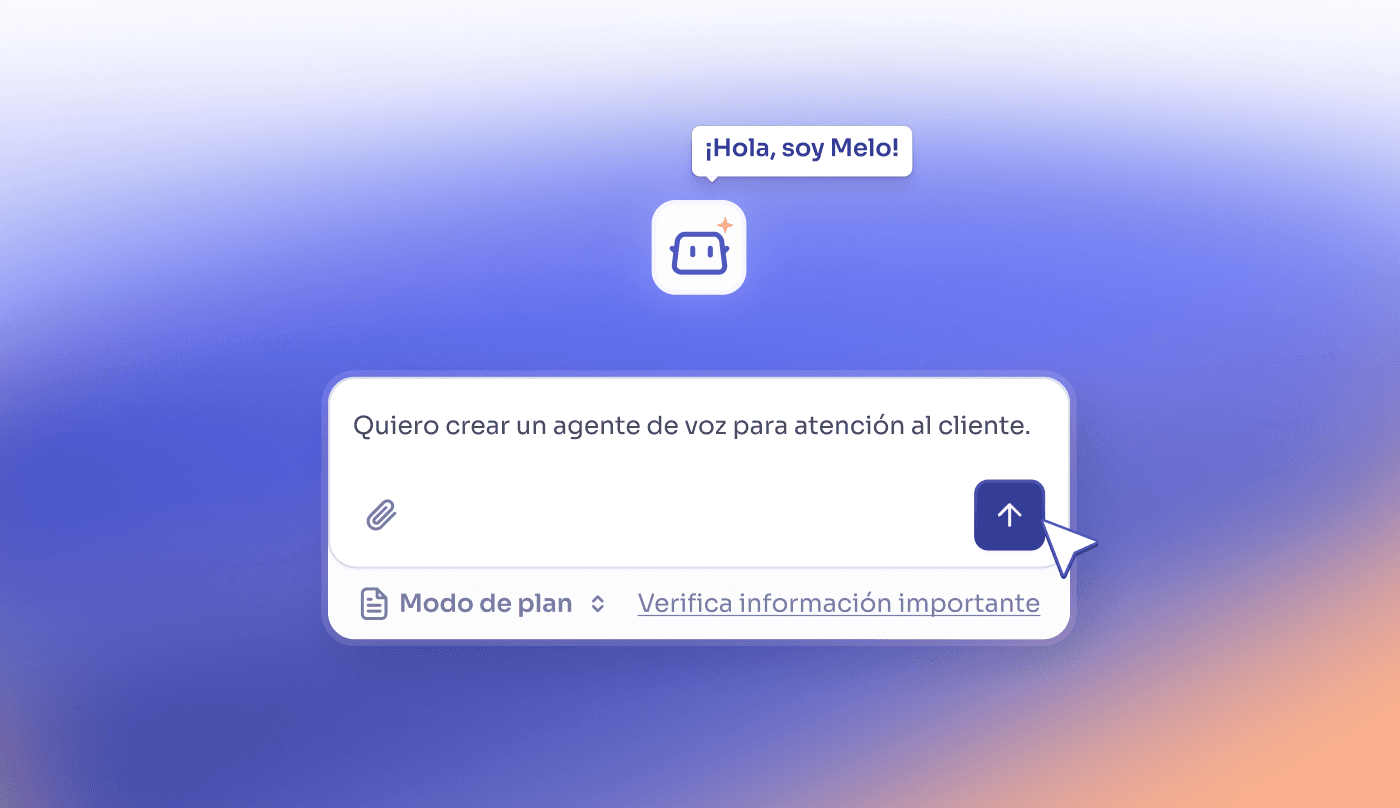
So, who is Melo? Melo is our copilot, and it is what happens when you apply the same idea that Lovable applied to applications to voice agents.
"I need an agent to answer calls at my clinic and schedule appointments." Simply tell this to Melo and it chooses the voice, writes the agent's instructions, sets up the call flow, and leaves it ready on a phone number. You simply describe, review, and confirm. What we described in the previous section is still necessary, it is just that now Melo takes care of everything.
What you can ask Melo
Creating the AI voice agent is only the beginning. From there, expanding it means continuing to talk about the capabilities your agent needs.
"I want it to know our hours and relevant clinic information." You pass it the PDF, or give it the entire website, and from there the agent reviews your real information instead of improvising. This is possible thanks to RAG systems.
"I need it to look up the client's order in our system during the call." Melo connects it to your CRM or your database, and the agent consults, creates, or updates data in the middle of the conversation, and gives the client their order number without anyone having to hang up and call back.
"When the call ends, it must send me a transcript by email and log the information in an excel sheet." Melo builds that automation with the services you already use like Gmail, Slack, your spreadsheet, your calendar, or your CRM.
And when something doesn't go as expected, you can ask Melo: "Why did this call fail?" It will open the log of what happened, what the agent decided, what tool it used, where it got stuck, and what the transcript says.
Even the boring part is done via chat: buying a number, seeing how many minutes you have left this month, inviting someone from your team. What takes five screens in another tool, here is just a question.
What Melo still doesn't know how to do
Melo is still not capable of doing everything, and as you increase the complexity of what you ask, you can see where it meets its limit.
Ask it for an agent that takes calls and books appointments and you will have it in minutes. Ask it for a three-tier support flow with escalation according to the type of incident, warranty validation against two systems, and different rules by country, and things change radically. Melo will set up the skeleton, but you will need to fine-tune each branch of the conversation flow. Defining a brand's exact tone or handling delicate and complex conversations is still iterative work where you must run tests, listen to calls, and correct.
It is similar with integrations. Connecting Gmail, a calendar, or a well-known CRM is easy. Connecting a custom ERP still requires someone who knows that system inside out. Melo prepares the ground; truly custom use cases still demand expert hands.
There is a range of complex problems that Melo cannot solve alone today. What it does do, however, is serve as the foundation to be able to build agents in Diga.
Why we believe this is the way forward
The pattern is the same everywhere and there is no turning back: creating is no longer a matter of knowing how to build and has become a matter of knowing what you want to build. It happened with software, it is happening with voice agents, and the implication for a business is that the advantage ceases to be "having someone who knows how to set it up" and becomes "knowing what you want your agent to do."
That is why we built Melo. For the agency that sets up agents for twenty clients without a technical team behind them. For the restaurant, clinic, or real estate agency that knows exactly how they want to answer the phone but has no reason to know about prompts or telephony. We prefer a copilot to handle that part so you can focus on your business, which is what you do know about.
The future of Melo
Today you ask Melo and it builds. Where it is headed is to do more and more without you having to ask for it in such detail.
First, to achieve what we mentioned, which is that tangled flows and custom integrations no longer require so much of you. Each version of the copilot tries to improve a bit in that area.
Second, and what matters most to us, is that Melo does not stop at creating the agent but accompanies it. It should look at how real calls are going and tell you "this agent hangs up a lot during the payment step, shall we adjust it?" or "half of the people ask about the hours and you do not have it in the knowledge base." Moving from a copilot that builds when you ask to one that observes, proposes, and improves with you.
And in the end, that more and more of the product fits into the conversation. That what are menus, tabs, and forms today becomes simply telling Melo what you want: creating, publishing, reviewing, and improving an agent, all by talking.
There is still a way to go for all of that, and we are on it. But the fundamental shift has already happened. Before, to have a voice agent, you needed someone who knew how to set it up. Today, you only need to know what you want it to do.